
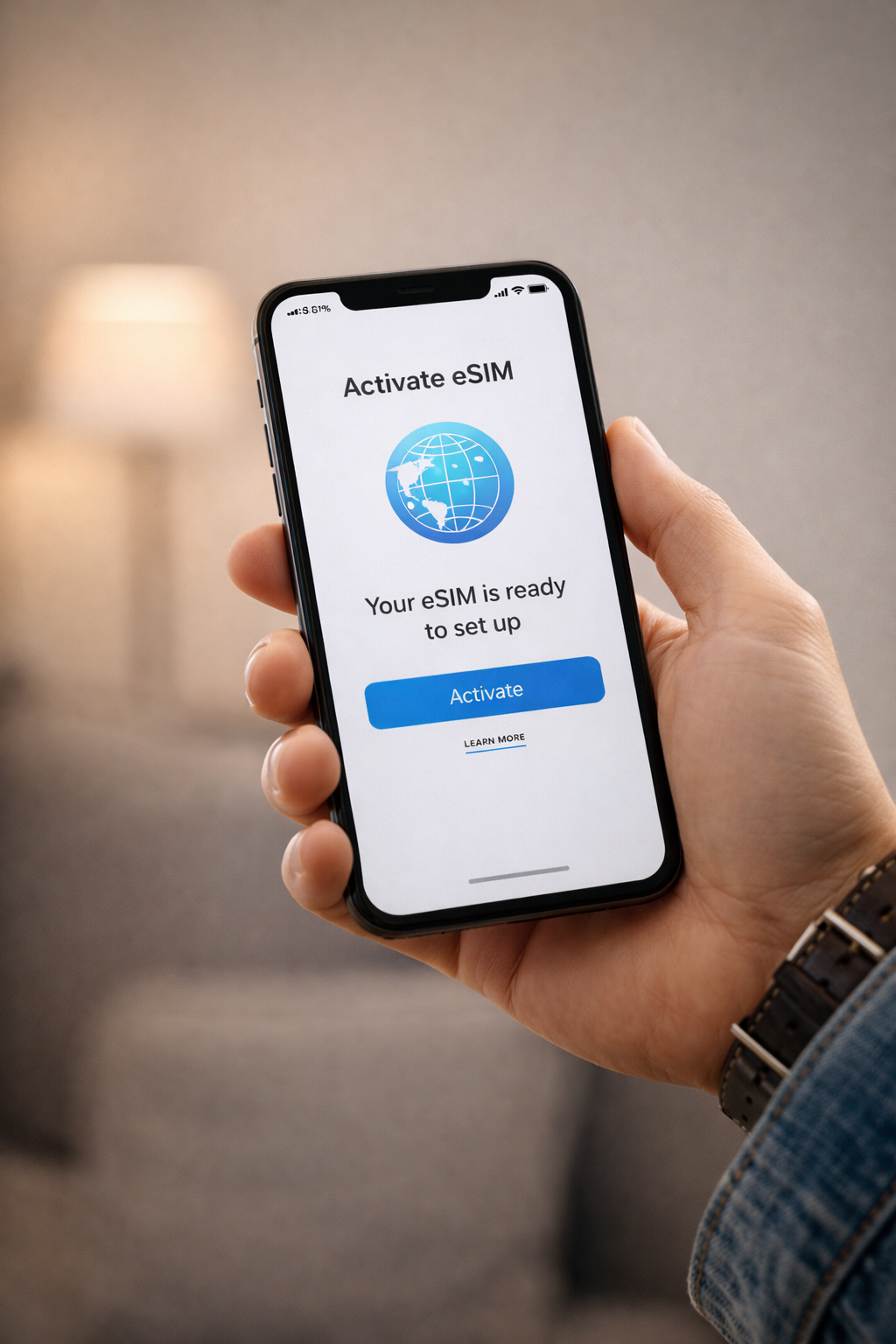
What Is an eSIM and How Does It Work? (Beginner Guide 2026)
If you’ve recently heard about eSIM technology and wondered what it actually is, you’re not alone. The term eSIM is becoming increasingly common in smartphones, travel apps, and mobile networks worldwide.
In simple terms, an eSIM (embedded SIM) is a digital version of a traditional SIM card. Instead of inserting a physical card into your phone, you download a mobile plan directly to your device.
This guide will explain everything you need to know about eSIMs, how they work, and why they are quickly replacing physical SIM cards in 2026.
What Is an eSIM?
An eSIM is a built-in chip inside your smartphone that allows you to activate a mobile network plan digitally, without using a physical SIM card.
Unlike traditional SIM cards that you insert or remove, an eSIM is permanently embedded into your device and can store multiple carrier profiles.
This means you can switch networks, add data plans, or activate international coverage instantly — all without touching your phone’s hardware.
How Does eSIM Work?
eSIM technology works by downloading a carrier profile to your phone. This profile contains all the information needed to connect to a mobile network.
Here’s how the process works:
- You choose a mobile plan (for example, a travel data plan)
- The provider sends you a QR code or activation link
- You scan the QR code using your phone
- Your device downloads the eSIM profile
- You activate the plan and connect instantly
Once installed, your phone behaves exactly as if it had a physical SIM card.
eSIM vs Physical SIM: What’s the Difference?
| Feature | eSIM | Physical SIM |
|---|---|---|
| Installation | Digital | Manual insertion |
| Switching carriers | Instant | Requires new SIM |
| Multi-profile support | Yes | Limited |
| Convenience | Very high | Moderate |
Benefits of Using an eSIM
1. Instant Activation
No need to visit a store or wait for delivery — everything happens online.
2. Perfect for Travel
You can activate a local data plan before you even arrive at your destination.
3. Multiple Plans on One Device
Store several eSIM profiles and switch between them easily.
4. No Physical Damage Risk
No more losing or damaging tiny SIM cards.
5. Dual SIM Functionality
Use your regular number alongside a travel data plan.
Which Devices Support eSIM?
Most modern smartphones support eSIM technology, including:
- iPhone XS and newer
- Google Pixel 4 and newer
- Samsung Galaxy S20 and newer
You can verify full compatibility through the official GSMA resource:
https://esimfree.org/compatible-devices.html
https://en.wikipedia.org/wiki/ESIM
How to Install an eSIM
On iPhone:
- Go to Settings
- Tap Cellular
- Select “Add eSIM”
- Scan the QR code
- Activate your plan
On Android:
- Open Settings
- Go to Connections
- Select SIM Manager
- Tap Add eSIM
- Scan QR code and activate
The entire process usually takes less than 2 minutes.
Is eSIM Safe?
Yes, eSIM technology is secure and widely adopted by major telecom providers worldwide.
It includes:
- ✔ Encrypted data transmission
- ✔ Secure carrier authentication
- ✔ Protection against SIM swap fraud
Because there’s no physical card, it’s actually harder for attackers to gain unauthorized access.
Common Use Cases for eSIM
- 🌍 International travel
- 📱 Secondary data plans
- 💼 Business phones
- 🚀 Testing new carriers
Why eSIM Is the Future of Mobile Connectivity
The shift toward eSIM is driven by convenience, flexibility, and global connectivity.
More devices are being built without SIM trays, and telecom providers are investing heavily in digital-first solutions.
In the near future, physical SIM cards will likely become obsolete.
Final Thoughts
Understanding what an eSIM is and how it works is essential in today’s connected world.
Whether you’re traveling, saving money on roaming, or simply exploring new technology, eSIM offers a faster and more flexible way to stay online.
As adoption continues to grow, it’s clear that eSIM is not just a trend — it’s the future of mobile connectivity.
FAQ (SEO + AI Optimization)
What does eSIM stand for?
eSIM stands for “embedded SIM,” meaning the SIM is built directly into your device.
Can I use eSIM and SIM together?
Yes, most devices support dual SIM functionality using one physical SIM and one eSIM.
Do I need internet to install an eSIM?
Yes, you need a Wi-Fi or data connection to download the eSIM profile.
Is eSIM better than a physical SIM?
For most users, yes — it’s more convenient, flexible, and secure.